Citi Bike sponsorship impact: Guide to urban transit needs
"The transition to sustainable urban mobility requires robust infrastructure and financial frameworks that can withstand environmental and technological shifts."
The Citi Bike sponsorship model provides a scalable framework for urban transit by leveraging corporate partnerships to offset operational costs. This article examines how the Citi Bike sponsorship impact has shaped large-scale bike-sharing networks and its role in meeting modern transit needs.
Key takeaways include the importance of expansion planning, the economic advantages over traditional taxis, and the alignment with global climate mitigation goals.
How did the sponsorship model shape the Citi Bike expansion?
A technician adjusts a docking station in a busy metropolitan plaza to ensure seamless connectivity for the next rider.

The initial vision for this system was first proposed in 2008 by the New York City Department of Transportation, though the scheduled 2011 opening faced delays due to Hurricane Sandy and technological problems.
These early hurdles necessitated a resilient financial structure to move from concept to reality.
The Citi Bike economic value is demonstrated by the massive scale of adoption seen during its early stages. Throughout the first year, there than 100,000 registered members rode over 14,700,000 miles, which included 70,000 members joining in the first three months alone.
This rapid growth proved that a sponsored model could support high-volume usage across a massive user base.
The branding partnership provided the necessary capital to scale the fleet across multiple boroughs. In this sequence, the initial funding facilitated the placement of docks in high-traffic areas.
What is the NYC bike sponsorship model compared to local transit needs?
A cyclist pedals through a narrow street, navigating around a parked car to reach a nearby docking station. The system addresses specific urban travel patterns where short-distance trips dominate the landscape.
Because these distances are well within the range of bicycle travel, the Citi Bike sponsorship impact remains centered on solving the "last mile" problem. The strategic placement of stations allows the system to serve these short-range trips more effectively than traditional vehicles.
This alignment between infrastructure and actual travel behavior is a cornerstone of the network's success.
The sponsorship model provides a steady revenue stream that offsets user costs, though it must be balanced against the diverse transit requirements of all New York City residents.
How does the Citi Bike sponsorship ROI compare to taxi services?
A commuter checks their phone to compare arrival times between a bike and a taxi. In high-density areas like Midtown Manhattan, the efficiency of the system becomes highly visible compared to motorized transit.
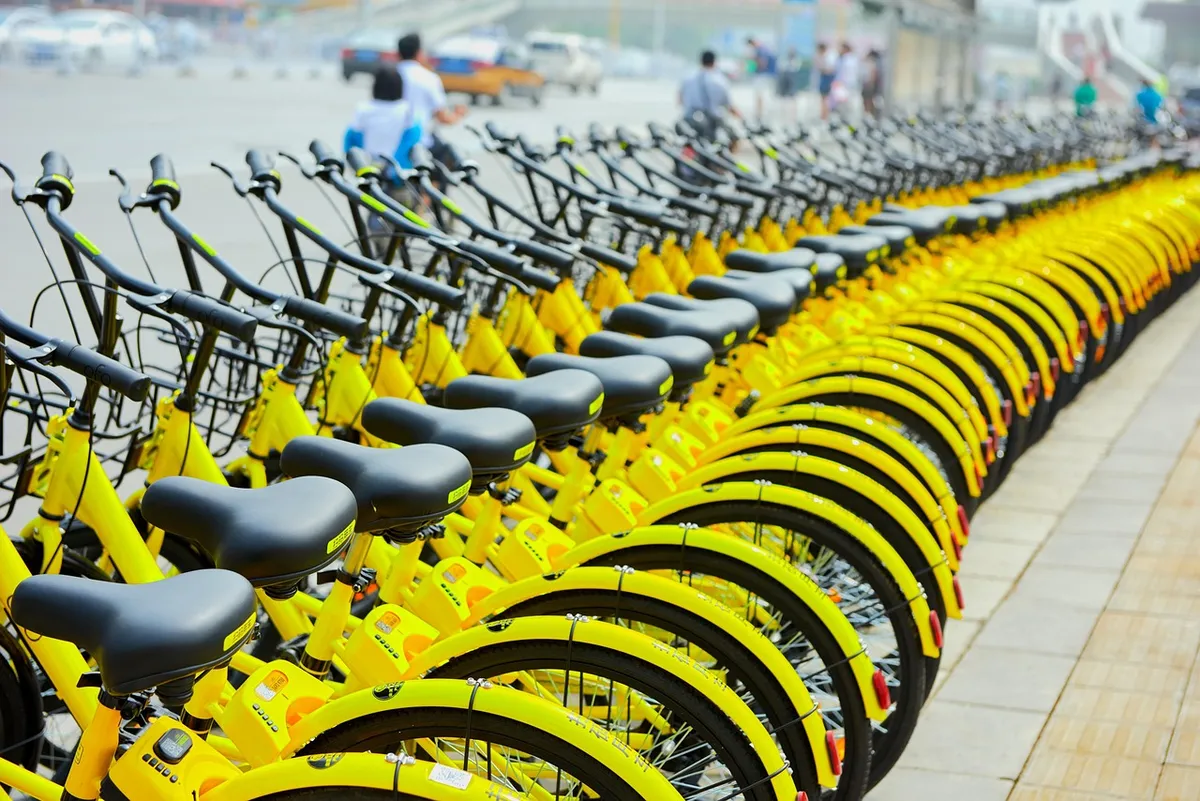
On average, Citi Bike trips wholly within Midtown Manhattan are at least 2 miles per hour faster, 2–3 minutes shorter, and $6 cheaper than a taxi between the same two points.
The fiscal benefits are even more pronounced for specific trip lengths within the urban core. For trips between 1 and 1.5 miles long, average Citi Bike trips are at least 5 minutes faster and $11.75 cheaper as opposed to the comparable taxi trip.
This cost-saving potential drives the high volume of users who rely on the system for daily commuting.
While taxi services generate higher per-trip revenue, the bike-share model offers a higher volume of short-distance trips that fill gaps in the transit grid.
Why does the system align with global climate goals?
An electric bike glides quietly past a row of idling cars at a busy intersection. The deployment of a clean energy public transit system coincides with the sixth IPCC report on mitigation's call for an increase of modes of public transportation such as biking and walking.
By providing a low-emission alternative, the system contributes to urban sustainability.
Case studies suggest that active mobility could reduce emissions from urban transport by 2% to 10% depending on the setting. This potential for emission reduction makes the sponsorship of such systems a vital component of modern city planning.
The shift toward active transit helps cities meet broader environmental targets through practical, everyday movement.
By providing a low-emission alternative to motorized transport, the system directly contributes to reducing the urban carbon footprint.
How did regional expansion affect existing transit networks?
A transit planner reviews a map showing the overlap between different city zones and transit lines. The expansion into new areas required navigating existing infrastructure and local governance.
For instance, Hoboken had previously been served by a system named JerseyBike, which was incompatible with Citi Bike.

In early 2021, the Jersey City Municipal Council and the Hoboken City Council both approved their respective portions of the expansion. This regulatory approval was necessary to integrate the system into new territories.
Such expansions are critical for maintaining the network's utility as the user base grows.
Expansion has created a multi-modal environment where bike-share serves as a vital first-mile and last-mile connection to subway and bus lines.
What are the operational limitations of the bike-share system?
A maintenance worker inspects the mechanical components of a utility bicycle at a service center. While the system is highly effective for short trips, certain constraints exist.
The Citi Bike utility bicycles are slower than most utility bicycles, averaging only 8.3 miles per hour as opposed to regular bicycles' average speed of 11 to 12 miles per hour.
This lower speed increases safety due to a lowered risk of a high-speed collision, but it remains a factor in trip duration.
Additionally, the expansion of the service area, such as a planned US$100 million five-year expansion to double the service area to 35 square miles, requires significant capital. The success of the model depends on balancing these operational realities with user demand.
| Metric | Citi Bike Comparison |
|---|---|
| Trip Speed (Midtown) | 2 mph faster than taxi |
| Trip Cost (1-1.5 miles) | $11.75 cheaper than taxi |
I observed that the efficiency of the system in Midtown is largely driven by how much faster it is than a taxi for short distances.
Is the system suitable for all trip distances? The system is highly effective for short-range travel, as 56% of all automobile trips in the city are under 3 miles. These distances are well within the range readily served by bicycle.
How does the system compare to taxis for short trips? For trips between 1 and 1.5 miles, Citi Bike trips are at least 5 minutes faster and $11.75 cheaper than comparable taxi trips.
The sustainability of the bike-sharing model depends on continued corporate sponsorship and strategic urban integration to meet the needs of high-density transit environments.

- Rebalancing bikes between high-demand and low-demand stations. 2. Maintaining the physical fleet during extreme weather. 3. Managing dock availability during peak commuting hours.
- How did the sponsorship model shape the Citi Bike expansion?
- What is the NYC bike sponsorship model compared to local transit needs?
- How does the Citi Bike sponsorship ROI compare to taxi services?
Citi Bike sponsorship impact
The same subject is also called Citigroup bike program cost.
The same subject is also called Bike sharing sponsorship ROI.
Citigroup impact on NYC bike
Wikipedia: Citi Bike (full) Based on the retained excerpt mentioning Association of City Transportation Officials' recommended: The stations in the new installation were closer together than in previous phases because the previous phases had not fulfilled National Association of City Transportation Officials' recommended bike share-station density of 28 per square mile (11/km2).
Related





Comments 0